How the Army Got Here
The Army walked away from this mission once. According to the Congressional Research Service, the Army divested its short-range air defense units in the early 2000s, and after 2005 that force was reduced to two active-component Avenger and C-RAM battalions and seven National Guard Avenger battalions. CRS In Focus IF12397, updated April 28, 2026.
Drones were part of the reason it came back. Breaking Defense reported in April 2021 that the Army decided in 2017 to revive its frontline anti-aircraft force "after witnessing the deadly impact of Russian drones in the 2014 invasion of Ukraine," and that the threats driving the program were drones, helicopters and attack aircraft. Breaking Defense, April 23, 2021. The Army had already published a counter-UAS strategy in July 2016, followed in April 2017 by ATP 3-01.81, Counter-Unmanned Aircraft System Techniques, which addressed "low, slow, small" air threats. CRS In Focus IF11426, updated April 17, 2023.
What changed since then is volume and variety. CRS notes that loitering munitions "have been employed with considerable effect" in the Russo-Ukraine and Iranian conflicts, and it cites "Iran's successful use of one-way attack drones against U.S. forces and installations in the Middle East." CRS IF12397. Congress has treated mass attack as its own problem: Section 162 of the FY2023 NDAA directs the Secretary of Defense to assess the threat from UAS swarms and to "develop and implement a strategy to field capabilities to counter threats posed by unmanned aerial system swarms." CRS IF11426.
What M-SHORAD Provides and What It Does Not
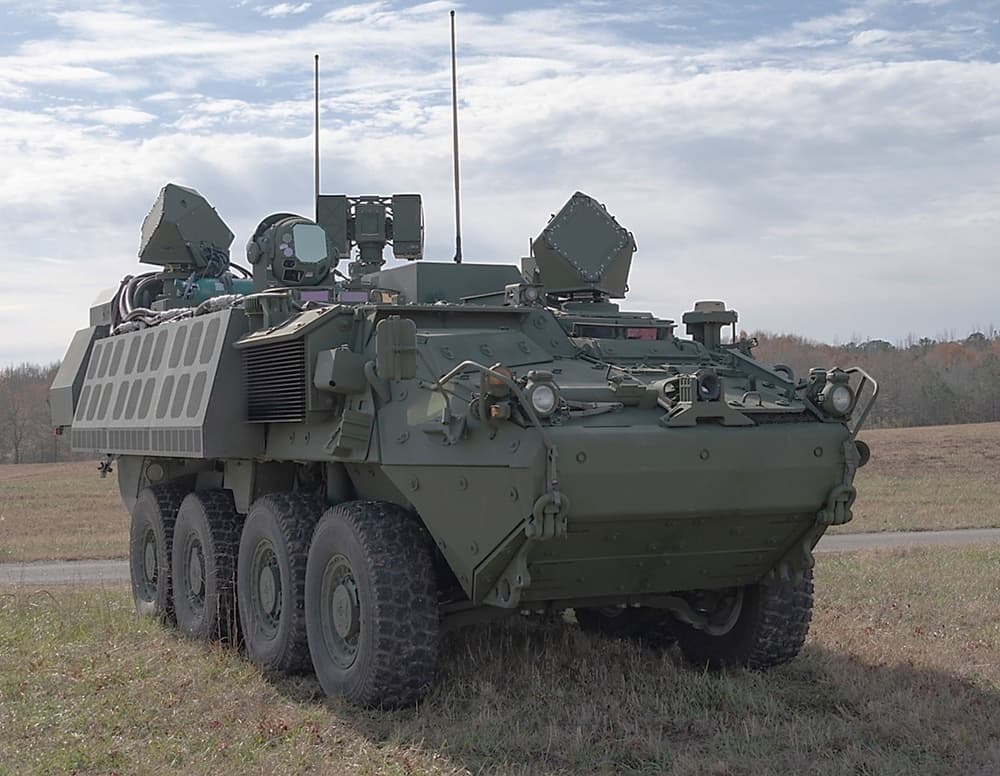
M-SHORAD Increment 1 is real capability. Per CRS, it is built on the M-1265A1 Stryker Double V Hull, with weapons and radar configured by Leonardo DRS and installed by General Dynamics Land Systems. Its configuration includes eight FIM-92 Stinger missiles in a dual launcher, an XM914 30 mm automatic cannon, an M-240 7.62 mm machine gun and a multi-mission radar. The 5th Battalion, 4th Air Defense Artillery Regiment in Germany received its first four systems in April 2021 and was fully equipped in late 2022. The Army reports 5-4 ADA, 4-60 ADA at Fort Sill, 6-56 ADA at Fort Hood and two-thirds of 3-4 ADA at Fort Bragg as fielded, at 36 vehicles per battalion, with Florida and Ohio National Guard fieldings planned for FY2028 and FY2029. CRS IF12397.
The Army is still adapting the effector set. CRS reports that Increment 3 is to add the Next Generation Short Range Interceptor (NGSRI) to replace Stinger, which had its first successful test flight in late 2025 with a single-vendor selection planned for FY2028, and the XM1223 Multi-Mode Proximity Airburst round for the 30 mm cannon, planned for late FY2028. The FY2027 request is $712.7 million in procurement for 14 SGT Stout systems and $460.9 million in RDT&E. CRS IF12397.
Our reading is that this is a capable platform carrying a finite magazine of missiles and a gun. Against a high volume of small, low-flying drones, the limiting factor is less the vehicle than whether every shot is cued by a good track, aimed at a correctly identified target and spent on a threat that cheaper or non-kinetic means could not handle.
The laser increment did not reach formations
Increment 2, the Directed Energy M-SHORAD, mounts a 50 kW laser. Breaking Defense reported that four Stryker-mounted 50 kW prototypes arrived in the CENTCOM region in early February 2024 for real-world experimentation, and that Army Vice Chief of Staff Gen. James Mingus said: "Is it 100 percent ready? Is it going to work perfectly? Probably not, but we're going to learn from it." He also said the Army's high-energy lasers are "so susceptible to weather" that dust storms degrade them. Breaking Defense, March 1, 2024.
CRS quotes an Army official saying the 50 kW power level was "proving challenging to incorporate into a vehicle that has to move around constantly," citing heat dissipation, electronics and tactical wear. According to the Army, after the FY2023 to FY2024 user assessment "the decision was made that no further procurement efforts would be undertaken, and the system would not be fielded to operational units." The FY2027 request instead includes $94.8 million for directed energy enhancements. CRS IF12397.
That matters for buyers. Breaking Defense reported that Pentagon leaders are grappling with a kinetic per-kill cost that "can be in the millions of dollars," and that directed energy, if it proves out in mass, "offers a window for significantly lowering that per-unit kill price point." Breaking Defense, March 1, 2024. For now, the fielded formation answer is kinetic and electronic, and that raises the value of a kill chain that spends each interceptor well.
The Kill Chain Integration Problem
The following five-step breakdown is Spartan X's analytical framing, not a doctrinal definition. Its purpose is to show where a point solution can leave a gap.
1. Detect. CRS describes three detection families: electro-optical, infrared or acoustic sensors; radar; and radio-frequency sensors that pick up control links. It notes that the first two "are not always capable of detecting small UAS due to the limited signatures and size of such UAS," that "many smaller UASs cannot be detected by traditional air defense systems due to their size, construction material, and flight altitude," and that the methods "can be—and often are—combined to provide a more effective, layered detection capability." CRS IF11426. The practical consequence: detection is a fusion problem, not a single-sensor purchase. RF sensing depends on the drone emitting, so a threat that flies a preprogrammed route without a live link offers less to listen for.
2. Track. A detection that cannot be held through sensor handoffs and terrain masking is a cue, not a firing solution. In our assessment, this is where systems bought separately most often fail to share a common picture.
3. Identify. The DoD strategy warns that "increasing numbers of sUAS will share the skies with DoD aircraft, operate in the airspace over DoD installations, and be employed by our Nation's adversaries." Discussing the homeland airspace environment, it also notes that commanders "are challenged to determine the intent of sUAS operations through procedural and positive airspace control measures." DoD C-sUAS Strategy, January 2021. In our assessment, the same problem follows a formation forward: friendly drones, allied aircraft and civilian traffic in the same low airspace make identification the node where an error carries the heaviest operational and legal cost.
4. Engage. CRS lists the defeat options: jamming the control link, and guns, nets, directed energy or traditional air defense systems. CRS IF11426. Choosing among them in seconds, and deconflicting a jammer from friendly links and other emitters, is a coordination task. In our view, manual processes will struggle to sustain it when attacks arrive in volume.
5. Assess. Confirming that a small drone was defeated, rather than merely lost from track, determines whether the next shot is needed. Small debris and short warning times make that harder than with larger aircraft.
A system that is excellent at one or two of these steps adds partial capability. Whether that becomes operational effect depends on how it connects to the others.
What the Department Has Already Said About Integration
The integration argument is not ours alone. The January 2021 DoD Counter-Small Unmanned Aircraft Systems Strategy, covering UAS groups 1, 2 and 3, states that the Department's initial emphasis on deploying government and commercially built materiel "resulted in many non-integrated, redundant solutions." Its objective 1.3 says: "The materiel component of our layered defense must be adaptable, integrated, and interoperable," and that systems "must share a common architecture" with "standardized interfaces" capable of plug-and-play. Objective 1.4 commits to test standards that evaluate capabilities "in operationally relevant conditions and environments, against operationally relevant threats." DoD C-sUAS Strategy, January 2021.
The strategy records that the Secretary of the Army was designated DoD executive agent for counter-small UAS in November 2019 and established the Joint C-sUAS Office, and CRS reports that office released the strategy in January 2021. DoD C-sUAS Strategy; CRS IF11426. DoD-level counter-drone organization may have changed since 2021, so buyers should confirm the current lead office and interface standards before writing requirements against them.
What Evidence Actually Changes the Decision
For a program manager or requirements officer, these questions separate integration depth from point capability:
- Threat coverage: Which UAS groups does the system address, and under what weather, electromagnetic and terrain conditions was that performance shown?
- Sensor fusion: How does it combine radar, RF and EO/IR inputs, and how does it hold tracks through handoffs?
- Identification confidence: What are the false-positive and false-negative rates against friendly and civil traffic at relevant speeds and altitudes, and how were they measured?
- Air picture integration: Does it feed the formation's existing air defense command and control, or does it need a parallel operator workflow?
- Navigation-degraded performance: How do detection and tracking hold up when GPS is jammed or spoofed?
- Operator workload: How many operators are needed at engagement tempo, and what training does that take?
Each answer should come with test evidence, not a vendor claim. That is the standard the 2021 strategy sets for itself.
The AI Integration Point and Its Limits
Machine learning is a natural fit for sensor fusion and classification: correlating tracks across sensors faster than an operator can, and sorting contacts by flight behavior or emission profile. Two limits define what it can contribute.
First, classifiers trained on yesterday's threats can be beaten by tomorrow's modifications. DoD Directive 3000.09 already sets the bar: autonomous and semi-autonomous weapon systems must undergo rigorous verification, validation and realistic test so that they "function as anticipated in realistic operational environments against adaptive adversaries taking realistic and practicable countermeasures." DoD Directive 3000.09, January 25, 2023, §1.2.a(1)(a). It also requires hardware and software designed with "technologies and data sources that are transparent to, auditable by, and explainable by relevant personnel" (§1.2.a(2)(c)). Meeting that bar over a program's life requires a pipeline for collecting operational data and updating models, which buyers should ask about at the start.
Second, engagement authority has to be designed in. The directive requires that these systems "be designed to allow commanders and operators to exercise appropriate levels of human judgment over the use of force" (§1.2.a), and that the human-machine interface clearly show "what actions operators need to perform and which actions the system will perform" (§1.2.a(3)(a)). It also exempts from the senior review required for other autonomous weapon systems "operator-supervised autonomous weapon systems used to select and engage materiel targets for local defense to intercept attempted time-critical or saturation attacks" for defense of installations and of platforms with onboard personnel (§1.2.d(2)), and for defending deployed remotely piloted or autonomous vehicles (§1.2.d(3)). DoD Directive 3000.09.
In our reading, much of formation counter-UAS falls close to that local-defense category. The design question is therefore how supervision and engagement authority are built into the system, not whether autonomy is permitted. Programs that present AI identification as a replacement for that authority chain, rather than support for it, should expect scrutiny in test, legal and fielding reviews.
The Credible Alternative: EW-Centric Defeat
Electronic warfare offers a different cost profile and avoids a kinetic engagement. CRS notes that jammers interfere with a drone's link to its operator and range from 5 to 10 pound man-portable units to vehicle-mounted systems. It reports that the Marine Corps tested the Marine Air Defense Integrated System (MADIS), which "employs jamming and guns," overseas in 2019, and that in July 2019 Marines aboard USS Boxer used MADIS to neutralize an Iranian UAS. CRS IF11426.
EW-first makes sense when threats depend on a control link, spectrum is manageable and the defended force can tolerate the side effects. It weakens against drones flying preprogrammed or onboard-guided routes, and it can interfere with friendly systems in congested spectrum. An adversary that expects jamming will adapt to it. The practical answer is layered: non-kinetic defeat where it works, with guns and interceptors held for threats that get through, all cued from the same track picture.
What Buyers Should Demand
- Require operationally representative test results against small, low-flying threats, not only larger targets.
- Require a live demonstration of integration with the formation's existing air defense command and control, not an interoperability claim.
- Set GPS-degraded and high-interference performance as threshold criteria.
- Require an identification-confidence specification tied to the rules of engagement and to the supervision model the system will run under DoDD 3000.09.
- Ask for the sustainment plan for AI models: the data pipeline, the retest process and the update cadence.
- Match technology maturity to the fielding schedule. The Army's own laser increment is the reminder that a promising prototype is not yet a formation capability.
The formation that wins this fight will not be the one with the largest magazine. It will be the one that completes detect, track, identify, engage and assess faster and more reliably than an adversary can saturate it.
Spartan X works on AI verification and tactical edge integration, including independently verifying AI outputs against stated constraints and operating conditions. That maps to the identification node discussed here: a classifier that enters the engagement chain needs evidence that it behaves as specified under degraded sensor inputs and adversary countermeasures, and data sources that the people responsible for it can audit and explain, as DoDD 3000.09 §1.2.a(2)(c) requires. Building that verification in before fielding is cheaper than discovering its absence during it.
Sources and further reading
- Congressional Research Service, U.S. Army's Maneuver Short-Range Air Defense (M-SHORAD) System—SGT Stout, IF12397, updated April 28, 2026 — congress.gov
- Congressional Research Service, Department of Defense Counter-Unmanned Aircraft Systems, IF11426, updated April 17, 2023 — congress.gov
- U.S. Department of Defense, Counter-Small Unmanned Aircraft Systems Strategy, January 2021 — defense.gov
- DoD Directive 3000.09, Autonomy in Weapon Systems, effective January 25, 2023 — whs.mil
- Breaking Defense, Sydney J. Freedberg Jr., report on the first M-SHORAD fielding, April 23, 2021 — breakingdefense.com
- Breaking Defense, report on 50-kilowatt laser Strykers sent to CENTCOM, March 1, 2024 — breakingdefense.com