What the award establishes
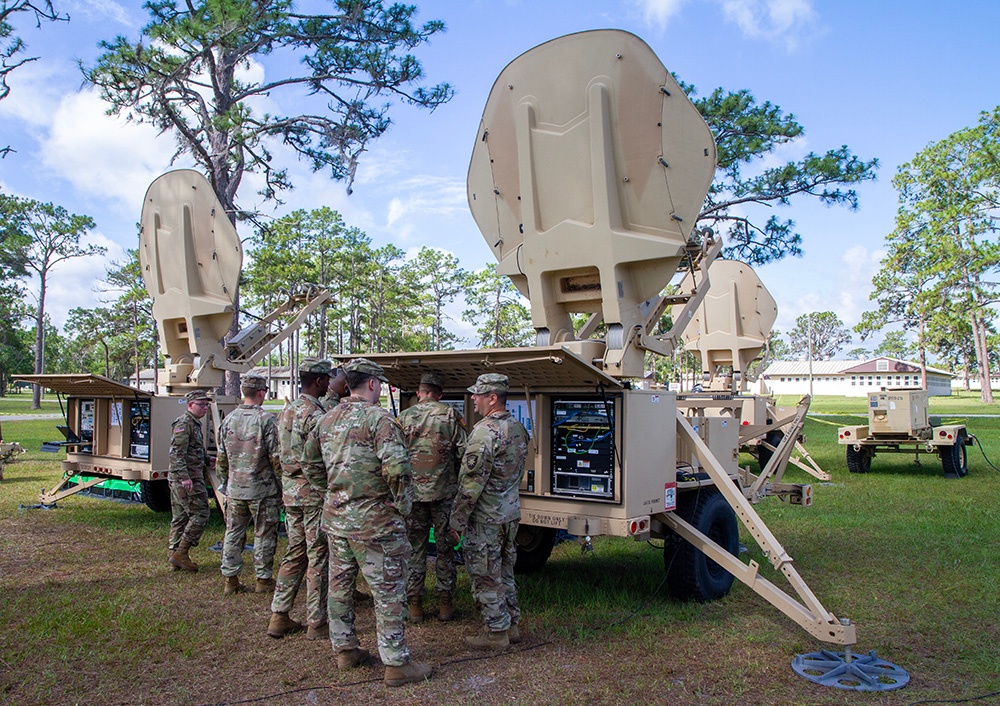
SSC's May 15, 2026 announcement identifies Northrop Grumman as the contractor for Enhanced Protected Tactical Satellite Communications–Prototype. The firm-fixed-price award develops and builds a prototype intended to improve performance under jamming and inform future protected SATCOM capability. Its expected launch window is a planning milestone, not operational availability today.
Space-based processing offers another place to implement protective functions and manage communications. It does not eliminate the ground segment's responsibilities. The payload, network management, user terminals and supporting security services must work together to deliver an authorized user's traffic under the intended conditions.
PTW also has a history beyond this prototype. The Space Force and UK Ministry of Defence demonstrated PTW over SKYNET in July 2020. Enhanced PTS-P builds on that broader development effort rather than introducing protected communications to space for the first time.
Keep anti-jam performance distinct from cybersecurity
Jamming interferes with a radio link. Unauthorized access, malicious software and compromised credentials create different failure paths. Some architectural measures support both resilience and security, but success against one threat does not establish protection against the others.
Space-based waveform processing should therefore be evaluated for its intended function. The public award announcement does not provide a basis for claiming that it eliminates replay attacks, automatically authenticates every user or prevents all spoofing. Those properties need their own design documentation and tests.
For the complete system, examine:
- Link availability: performance in the specified interference environment, including throughput and recovery.
- User access: terminal authorization, credential handling and removal of compromised access.
- Control integrity: protection of commands, configuration changes and software updates.
- Processor resilience: isolation of functions, anomaly handling and recovery after faults.
- Operational continuity: what users can accomplish when protected capacity is constrained or unavailable.
Moving processing on orbit also introduces hardware, software and update dependencies that must be managed over the spacecraft's life. A single integrator does not automatically make those dependencies safer. Clear ownership and testable interfaces make the risk easier to control.
Proliferation and protection solve different parts of the problem
More satellites and more paths can improve availability when a node is lost or a route is unavailable. Their value depends on coverage, capacity, terminal compatibility and how quickly traffic can move to another path. Link protection addresses the performance of a particular communications connection under interference.
Those measures can reinforce one another. It is equally misleading to assume that constellation size makes jamming irrelevant or that a protected waveform makes architectural diversity unnecessary. Programs should test their actual alternatives rather than treating either approach as a universal answer.
Put communications assumptions into the mission test
For joint command and control, a data feed is useful only when it arrives with sufficient quality and timeliness for the task. Loss of a link can reduce the value of fused information, but local processing, stored data and alternate paths may preserve some mission functions.
- Identify the traffic and latency limits that matter to the mission.
- Confirm which terminals and services support the intended protected waveform.
- Test the complete path under representative interference and cyber conditions.
- Exercise loss, restoration and movement to alternate communications.
- Align delivery plans with demonstrated availability, including interim connectivity before the new prototype is operational.
For suppliers, credible evidence can include controlled interference testing, secure key-management design and monitoring behavior appropriate to the system. Digital models can support assessment when they represent the relevant implementation, but a model does not replace testing or create a blanket contractual requirement. The solicitation and applicable standards determine what must be delivered.
Sources and further reading
- SSC Enhanced PTS-P award announcement, May 15, 2026
- Space Force–UK PTW demonstration over SKYNET, 2020
Spartan X’s cybersecurity and systems engineering practices focus on these end-to-end dependencies, translating protected communications requirements into integration, test and continuity plans that support the mission.