What the Army Set Out to Build
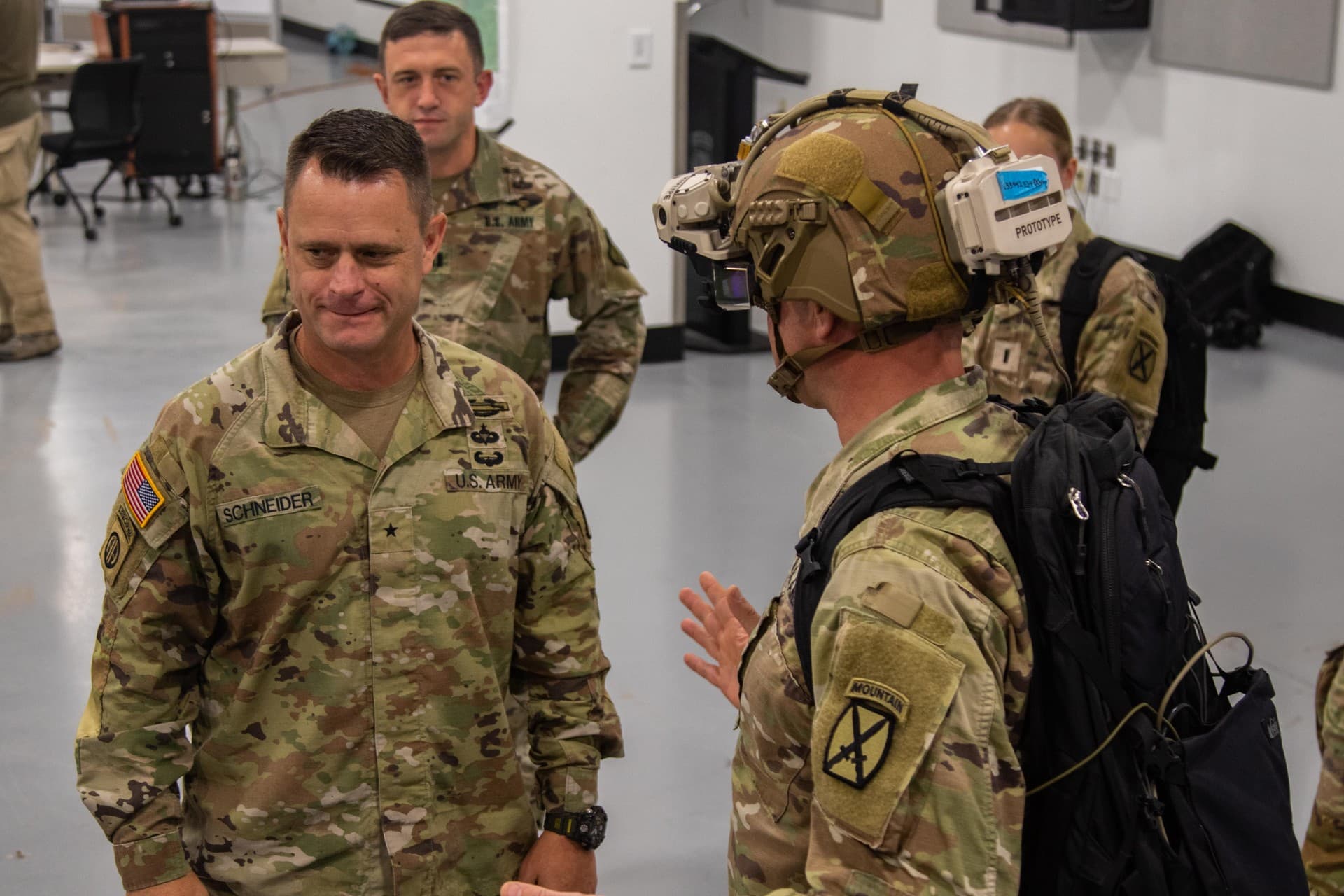
GAO describes IVAS as "a commercial augmented-reality headset that Microsoft modified for Army use," combining a display, sensors and an on-body computer "intended to improve situational awareness, decision-making, and target acquisition" (GAO-25-107546, September 2025). According to DOT&E's FY2022 annual report, the system included a heads-up display with integrated thermal and low-light sensors, a body-worn computer, a networked data radio, three conformal batteries per soldier and situational-awareness software. A wireless link connected the soldier's weapon sight to the display. The Army intended to equip more than 100,000 close combat soldiers (DOT&E FY2022 IVAS entry, archived copy).
The concept was sound. Navigation cues, a shared operational picture and weapon-sight imagery sit in the soldier's field of view, so the soldier never has to look down at a handheld device. The same architecture is where AI-dependent functions would live. Automated target cueing, sensor fusion and machine-assisted navigation all need a display, sensors and on-body compute. That is Spartan X's analysis of where such a platform leads, not a description of what IVAS delivered. The program record we reviewed does not show an AI target-recognition capability being fielded. Still, the human factors lessons apply directly to AI-enabled wearables, because those systems will have the same weight, display and fatigue constraints, plus their own model-performance questions.
IVAS ran on the Middle Tier of Acquisition (MTA) pathway, not the traditional major capability pathway. GAO explains that Section 804 of the National Defense Authorization Act for Fiscal Year 2016 required DoD to establish guidance for this alternative process, that DoD "intends for MTA to facilitate rapid prototyping and rapid fielding of capabilities within 2 to 5 years of a program's start," and that DoD "generally exempts MTA programs from its traditional acquisition and requirement development policies" (GAO-23-105008, February 2023). That matters for the lessons below. GAO's IVAS profile records the key approvals as decisions by the program executive officer, the component acquisition executive (who retained decision authority) and USD(A&S) (GAO-23-105008, p. 71). In Spartan X's view, that structure means a program on this pathway cannot count on a standard framework review to force a human factors examination. If the discipline is wanted, it has to be written into the program's own agreements and decision points.
How Production Got Ahead of the Evidence
The order of events is the core of the case, and the primary record is clear.
- December 2020: rapid fielding approved, with conditions. After the third capability set was tested, the Under Secretary of Defense for Acquisition and Sustainment approved moving IVAS from rapid prototyping to rapid fielding. That approval authorized the Army to procure up to 10,000 systems, and it required the Army to fix problems found in testing and verify the fixes before the operational demonstration and fielding (DOT&E FY2022; GAO-23-105008).
- March 2021: production contract awarded. GAO reports that "the program awarded its production contract in March 2021. But, as of October 2022, Army officials stated the prototyping effort had yet to verify fixes necessary to address these deficiencies, which are needed to inform production activities" (GAO-23-105008). GAO later described the award as a 10-year production other transaction agreement valued at up to $21.9 billion, which the Army later reduced in scale (GAO-25-107546).
- 2021: the operational demonstration slips. Based on results from soldier touchpoint and user jury events in April and July 2021, the Army delayed the operational demonstration from September 2021 to May and June 2022 to allow time to correct deficiencies (DOT&E FY2022).
- April 2022: the Inspector General flags the missing threshold. The DoD Inspector General found that Army testers had surveyed soldiers and used the results to change the system. However, "IVAS program officials did not define minimum user acceptance levels to determine whether IVAS would meet user needs," because Army policy did not require it. The IG warned that buying IVAS without user acceptance "could result in wasting up to $21.88 billion" (DODIG-2022-085, full report, p. i, archived copy).
The Assistant Secretary of the Army (Acquisition, Logistics, and Technology) disagreed with the IG's call for new Army-wide policy, stating that existing Army regulations already govern user acceptance input "as measures of effectiveness and measures of suitability." The IG rated the recommendation unresolved, noting that for IVAS "user acceptance is a measure of effectiveness, but thresholds and objectives are not clearly specified due to lack of Army policy" (DODIG-2022-085, full report, p. ii and p. 21). That exchange is the human factors debt in a single sentence: user acceptance was measured, but nothing was tied to it.
What the Operational Demonstration Found
The Army ran the IVAS 1.0 operational demonstration at Fort Bragg in June 2022 under a DOT&E-approved test plan. It included two 72-hour company missions with IVAS, one 72-hour mission with soldiers' current equipment, and day and night live-fire ranges. DOT&E reported the following (DOT&E FY2022):
- The infantry company was more successful accomplishing its missions with current equipment than with IVAS 1.0. On the buddy-team live-fire range, soldiers using IVAS hit fewer targets and engaged them more slowly.
- "User acceptance remains low." Soldiers preferred their current Nett Warrior and night vision devices.
- "The majority of soldiers reported at least one symptom of physical impairment to include disorientation, dizziness, eyestrain, headaches, motion sickness and nausea, neck strain and tunnel vision."
- Soldiers cited poor low-light performance, display quality, cumbersomeness, poor reliability, inability to distinguish friend from foe, difficulty shooting and limited peripheral vision.
- IVAS 1.0 did not show improvements in the low-light sensors, display, weapon-sight integration or field of vision that earlier testing had identified.
The reliability record shows why a single metric snapshot is not enough. DOT&E reported that the prior engineering version, Capability Set 4 Engineering Version 3, met its requirement for mean time between system aborts (MTBSA) at the March 2022 Soldier Touchpoint 5. IVAS 1.0, the version tested in the Ops Demo to support the production and rapid fielding decision, did not hold that result: its MTBSA "declined during Ops Demo" compared with the earlier Engineering Version 2, although DOT&E judged that MTBSA "is improving" overall. Results for mean time between essential function failures "have not improved" across Engineering Versions 2 and 3 and IVAS 1.0, and soldiers listed poor reliability among their reasons for dissatisfaction (DOT&E FY2022). Spartan X's lesson for specification writers: a reliability requirement met once, on a different configuration, says little about the configuration that will actually be fielded. Tie the production decision to the full set of reliability measures, measured on the production-representative configuration during sustained operational use.
The Restructure and Where It Ended
After the demonstration, the Army changed its acquisition and fielding strategy. DOT&E reported plans to field 5,000 IVAS 1.0 systems and 5,000 IVAS 1.1 systems with an improved low-light sensor, with IVAS 1.2 becoming the full-rate production system with a new form factor (DOT&E FY2022). In August 2023, the Army announced it had accepted its first IVAS 1.2 prototypes, with 20 slated for a two-squad user assessment that month. It described them as having a lower-profile display, a distributed counterweight for comfort, an improved low-light sensor, reliability upgrades and a hinged mount that lets soldiers flip the display up. It also said the 1.0 and 1.1 versions would support training (Army.mil, Aug. 1, 2023). The redesign came after the production commitments, not before them.
In February 2025, Microsoft announced that Anduril would "assume oversight of production, future development of hardware and software, and delivery timelines" for IVAS, subject to Department of Defense approval (Microsoft, Feb. 11, 2025). In September 2025, GAO reported that the Army had obligated about $1.4 billion as of April 2025 and planned to recompete a design-and-prototype agreement for a new version of the headset (GAO-25-107546).
GAO's June 2026 report describes the outcome. The "estimated $1.8 billion IVAS program" has "yet to deliver operational capability after three different acquisition efforts and system versions developed since 2018." The nearly 10,000 units of the first two versions "have fallen short of soldiers' needs and will go into storage, with some potentially used for testing." The Army plans a new rapid prototyping program, Soldier Borne Mission Command (SBMC) (GAO-26-109135).
Three Structural Causes
The causes below are Spartan X's reading of the record. They are not findings any single oversight body has stated in these words.
User acceptance was measured but not made a requirement. The IG's finding is the center of the case. The program used soldier-centered design and surveys, so it had feedback. What it lacked was a threshold the production decision had to clear. Without a number, poor survey results become inputs to the next iteration instead of grounds to stop. The same thing happens when an AI component's operator trust or false-alarm tolerance is surveyed but never specified.
The production commitment came before the evidence. Testing found problems early, before the December 2020 fielding approval, and the approval itself required verified fixes. The production contract still came in March 2021, while those fixes remained unverified into late 2022 (GAO-23-105008). The problem was not that human factors testing came late. The problem was that the schedule did not wait for it. GAO's June 2026 report describes the broader pattern as programs structured to "fail slow" while "DOD is incentivized to award massive development contracts and obligate funds quickly" (GAO-26-109135).
Laboratory or apparatus performance does not survive the field. IVAS's complaints about low-light performance, display quality and field of vision were field findings from 72-hour missions. AI subsystems carry the same risk in a sharper form. Suppose, hypothetically, a thermal contrast enhancement model scores 95% on a curated test set. Its field performance could be very different once the sensor heats up, the soldier is moving and sweat fouls the optics. A specification that defines AI accuracy without defining operating conditions allows a lab pass rate that tells you little about the field.
What Buyers Should Require
These are recommendations, not current DoD requirements. Each one maps to a specific gap in the IVAS record.
- Put a human factors test plan and numeric user-acceptance thresholds into the prototype agreement. On the traditional pathway, that plan belongs at the development decision. For MTA and other-transaction programs like IVAS, which GAO describes as generally exempt from the traditional acquisition policies, write it into the prototype agreement and the production-transition decision. The plan should name the user population, the representative tasks, the worst-case environmental conditions and the minimum acceptance scores. Write those requirements against the operational population, not the design case. As a hypothetical illustration, a fit requirement written for a 95th-percentile male head form, tested bare-headed in a lab, says nothing about a smaller soldier wearing an Advanced Combat Helmet (ACH), eye protection and cold-weather gloves who must operate the controls prone or at night. The specification should state the helmet, eyewear, gloves and body positions the system must work with, and the acceptance test should use them. A human factors engineer with defense-system experience should prepare or review it.
- Make production quantity depend on verified fixes, not promised ones. If the approving authority requires deficiencies to be corrected before fielding, as USD(A&S) did for IVAS, the production option should not be exercised until an independent test confirms the fixes. Write the approval condition into the agreement as an exercise condition so that it cannot be bypassed.
- Require sustained-use data before production quantities. The IVAS demonstration's 72-hour company missions are the right model. They surfaced fatigue, discomfort and reliability failures that short sessions miss. For anything worn, carried or continuously operated, compare the new system against the current equipment it is meant to replace, under the same conditions.
- Budget human factors engineering as a named line. When this work sits inside a broad systems engineering line, oversight cannot see it, and it gets absorbed when schedule pressure arrives. A named line with its own milestone makes someone accountable for it.
- Write AI performance requirements against operating conditions. Define accuracy, false-alarm rate and latency across temperature, motion, sensor degradation, communication loss and data quality, not only on clean inputs.
- Require failure-mode documentation before production. For AI components, the program should document and defend the input, data and environmental conditions under which the model degrades or fails. If that document is missing, the edges of the performance envelope have not been tested.
The Credible Alternative
The Army's position deserves a fair hearing. MTA exists to move faster than the traditional pathway. The Army argued that existing measures of effectiveness and suitability already covered user acceptance, that specific quantifiable user-acceptance measures set at the DoD or Army level "could impede the Army's ability to tailor programs or remain agile and adaptable," and that the $21.88 billion figure was misleading because it was a 10-year contract ceiling that included all possible sales to the Services and foreign military sales (DODIG-2022-085, full report, pp. 19 and 21). Those are fair points. The IG's answer was not one fixed measure for every program but a policy letting each program set its own tailored thresholds and objectives (same report, p. 21). Committing to production before every fix is verified can be the right call in some cases: the item is cheap to replace, it imposes little physical burden on the user, it builds on a mature commercial product with a known human interface, or an urgent operational need outweighs the risk of buying something soldiers dislike. In those cases, demanding full sustained-use data first can cost more in delay than it saves.
The test for whether IVAS fit those conditions is the outcome itself. IVAS was a head-mounted system worn for long missions, it caused physical symptoms in most test soldiers, and the bill reached roughly $1.8 billion by GAO's estimate. It was close to the worst case for concurrent production. The tradeoff should be made explicitly: the person who accepts concurrency risk should name the user-acceptance threshold being waived and the cost of being wrong.
Who Owns the Fix
- Program managers own the test plan, the thresholds and the named budget line.
- The milestone or decision authority, which for IVAS was the Assistant Secretary of the Army (Acquisition, Logistics, and Technology) according to the IG (DODIG-2022-085, full report, p. ii), owns the decision to proceed without meeting them.
- Independent testers own the sustained-use evidence and the comparison against current equipment.
- Contracting officers own the exercise conditions that make approvals binding.
Evidence That Would Change This Analysis
This guidance assumes the IVAS pattern applies to other programs: that missing acceptance thresholds and production commitments made ahead of the evidence produce expensive late failures. Several findings would weaken that assumption.
- If SBMC's prototype agreements carry quantified user-acceptance criteria and the program still fails on similar grounds, the cause is more likely immature technology than process, and the remedy would be longer technology maturation rather than better contract terms.
- If programs with strong human factors traditions, such as aircrew systems, show the same late failures despite early investment, the argument for early spending is weaker than it looks here.
- If a rapidly fielded wearable system succeeds without sustained-use testing, that would show where the concurrency tradeoff can work.
IVAS 1.2 no longer settles the question. GAO reports that the program is moving to storage and a new start (GAO-26-109135). The useful question now is whether SBMC's prototyping agreements include the human factors acceptance criteria that IVAS lacked.
Questions for the Next Program Review
For SBMC, or any AI-enabled wearable or squad-level system now in prototyping, ask:
- What is the numeric user-acceptance threshold, and which decision does it control?
- Which deficiencies must be verified as fixed before a production option can be exercised, and who verifies them?
- Has the system been compared against current equipment on missions of realistic length?
- Under which documented operating conditions do the AI components degrade, and how were those conditions tested?
- Is human factors engineering a named budget line with its own milestone?
A program that cannot answer these questions is accepting concurrency risk whether or not anyone has said so.
Sources and further reading
- GAO, Weapon Systems Acquisition: Beyond Business as Usual, GAO-26-109135, June 9, 2026: https://www.gao.gov/products/gao-26-109135
- GAO, Other Transaction Agreements: Improved Contracting Data Would Help DOD Assess Effectiveness, GAO-25-107546, September 2025: https://www.gao.gov/assets/gao-25-107546.pdf
- GAO, Middle-Tier Defense Acquisitions: Rapid Prototyping and Fielding Requires Changes to Oversight and Development Approaches, GAO-23-105008, February 2023: https://www.gao.gov/assets/gao-23-105008.pdf
- Director, Operational Test and Evaluation, FY2022 Annual Report, IVAS entry (Internet Archive copy of the official PDF): https://web.archive.org/web/20230515045852/https://www.dote.osd.mil/Portals/97/pub/reports/FY2022/army/2022ivas.pdf
- DoD Office of Inspector General, Audit of the Army's Integrated Visual Augmentation System, DODIG-2022-085, April 20, 2022 (Internet Archive copy of the full report PDF): https://web.archive.org/web/20220422133850/https://media.defense.gov/2022/Apr/22/2002981953/-1/-1/1/DODIG-2022-085.PDF
- U.S. Army, Army accepts prototypes of the most advanced version of IVAS, August 1, 2023: https://www.army.mil/article/268702/army_accepts_prototypes_of_the_most_advanced_version_of_ivas
- Microsoft, Anduril and Microsoft partner to advance Integrated Visual Augmentation System (IVAS) program for the U.S. Army, February 11, 2025: https://news.microsoft.com/2025/02/11/anduril-and-microsoft-partner-to-advance-integrated-visual-augmentation-system-ivas-program-for-the-u-s-army/
The AI accuracy part of the IVAS gap is accuracy claims made on clean, controlled inputs that do not hold under operating conditions. That is where Spartan X's Arbiter practice applies: cross-checking AI outputs through multi-model consensus and adversarial review so that accuracy claims are tested against degraded and edge-case inputs, not only clean ones. That kind of evidence belongs in the file before the production decision, not in the operational test report that follows it.