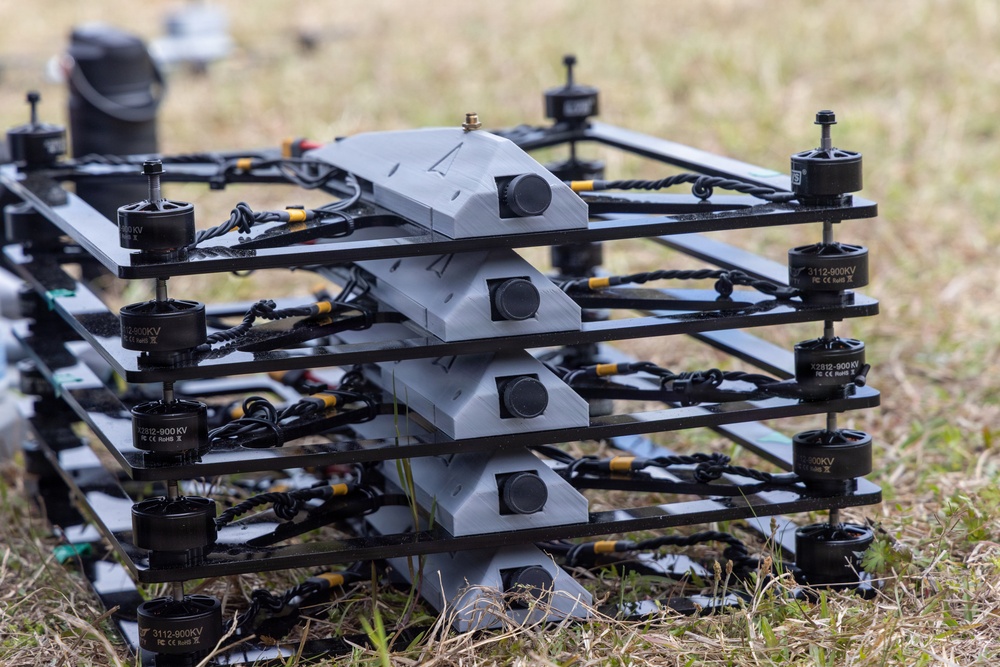
On March 31, 2026, Northrop Grumman's Lumberjack Group 3 uncrewed aircraft system flew a simulated precision strike mission during Operation Lethal Eagle, the 101st Airborne Division's division-wide large-scale combat operations training exercise at Fort Campbell. The mission itself — a one-way attack profile using surrogate Hatchet miniature munitions followed by a transition to persistent ISR — was not unprecedented. What made the demonstration operationally significant was the software layer underneath it. Lumberjack was integrated into Palantir's Maven Smart System and operated in conjunction with the Agentic Effects Agent, an AI component that automatically identified targets, analyzed battlefield data, and recommended actions to human operators in real time. This was the first customer demonstration where Lumberjack was integrated into Maven for live mission planning and monitoring from a forward-deployed command and control ground station. The gap between those two sentences — between the hardware platform and the AI layer directing it — is where the real doctrinal shift is occurring.
The term "agentic AI" has accumulated considerable ambiguity in the defense technology space. In this context it has a precise meaning: the Agentic Effects Agent is not a passive analysis tool that surfaces information for a human analyst to interpret. It actively proposes effects — target identifications, action recommendations, sequencing suggestions — that a human operator then approves, modifies, or rejects. This is the distinction between AI that accelerates human cognition and AI that participates in the decision cycle as a functional element. The human remains on the loop and retains authority over every action taken. But the loop itself has contracted. The sensor-to-shooter timeline that once required analysts to process imagery, populate a target list, route recommendations through a chain of command, and execute a tasking order now compresses to a sequence where the AI system delivers a cueable recommendation and a commander authorizes the effect. The operational implication is a targeting cycle that can operate faster than an adversary can re-plan or reposition — which is precisely the decision-speed advantage that JADC2 has sought since the concept was formalized.
The Maven Program of Record and What Institutional Permanence Means
The Lumberjack demonstration did not occur in isolation. In a March 2026 directive, Deputy Secretary of Defense Steve Feinberg formally designated the Maven Smart System as a program of record, directing its transfer from the National Geospatial-Intelligence Agency to the Chief Digital and AI Office within thirty days and routing future contracting authority to the U.S. Army. Maven's platform investment has grown from approximately $480 million in 2024 to $13 billion committed for multi-year development and integration — a scale that reflects a decision to treat AI-enabled command and control not as an experimental capability but as foundational infrastructure. Making Maven a program of record achieves something that rapid prototyping and other transaction authority vehicles cannot: stable, multi-year funding with enterprise-wide integration mandates. Every service, not just the early adopters, now has a procurement pathway into a common AI-enabled C2 platform. The Feinberg directive also explicitly frames Maven as the cornerstone of Combined Joint All-Domain Command and Control — which means the agentic capabilities demonstrated at Operation Lethal Eagle are being designed into the foundational architecture of how the joint force will fight.
The industrial base implications are significant. Open architecture standards — specifically the Open Mission Systems and Universal Command and Control Interface frameworks — require that platforms operating within Maven-integrated workflows expose standardized APIs for mission tasking, telemetry, and payload integration. This means attritable platforms like Lumberjack can be managed through a common C2 infrastructure regardless of vendor, and that the targeting loop can accommodate systems from multiple primes without re-engineering the command layer. For defense technology companies building into this ecosystem, compliance with open architecture mandates is no longer a differentiator — it is the minimum entry requirement. The evaluation criteria are shifting from platform performance under ideal conditions to demonstrated interoperability with the AI-enabled C2 stack in contested environments.
The Human-Machine Teaming Question the Field Has Not Yet Resolved
What Operation Lethal Eagle surfaced, and what the Maven program of record decision accelerates, is a doctrinal question the defense community has not fully answered: at what decision nodes should agentic AI generate recommendations versus receive tasking, and how are those boundaries established and enforced programmatically rather than by policy alone? The current model — AI proposes, human authorizes — satisfies the Department of Defense's existing directive on autonomous weapons and reflects the measured approach articulated in the updated DoD AI Ethics Principles. But the compression of the targeting cycle creates its own pressures. When the Agentic Effects Agent is surfacing recommendations faster than a human operator can independently verify the underlying analysis, the "authorization" step risks becoming a confirmation bias loop rather than a genuine control mechanism. This is not a reason to slow the program — the operational necessity is real and peer competitors are not pausing to resolve the same philosophical tensions. It is, however, the architectural and doctrinal challenge that distinguishes serious AI-enabled C2 development from capability demonstration.
The path forward requires two things simultaneously: expanding the operational scope of agentic AI at the tactical edge and developing the verification frameworks that allow human supervisors to exercise meaningful oversight at decision speeds the technology enables. Explainability requirements — the ability of an AI system to surface not just a recommendation but the specific sensor data, model outputs, and reasoning chain that produced it — are a technical prerequisite for genuine human control at machine speed. The same open architecture mandates that enable platform interoperability need to extend to the AI reasoning layer: standardized interfaces for accessing model confidence scores, training data provenance, and decision logic are as important for operational commanders as standardized interfaces for mission tasking. As Maven scales from a program of record to enterprise-wide integration, and as the Replicator and Swarm Forge programs push AI-enabled coordination further down to the platform layer, the defense community will need both the hardware demonstrations and the architectural standards to make them operationally trustworthy. Operation Lethal Eagle showed that the hardware and AI integration are ready for the next evaluation. The doctrinal and architectural work is where the next demonstration needs to happen.