The Pentagon's Replicator initiative was announced in August 2023 with a deliberately ambitious framing: field thousands of attritable autonomous systems across multiple domains within 18 to 24 months. The intent was to demonstrate that the United States could compete with a peer adversary's capacity to mass low-cost unmanned platforms not by outspending it on exquisite systems, but by out-fielding it at volume and speed. Two and a half years later, the program has evolved into something more structurally significant than its original procurement mandate. Swarm Forge — the operational experimentation program that grew alongside Replicator — is preparing for its June 2026 Crucible demonstration, and the capability benchmarks being set there will define the technical floor for autonomous systems acquisition for the next decade.
The Crucible is not a combat exercise. It is a structured stress test: autonomous platforms from multiple vendors, operating in contested electromagnetic environments, executing coordinated mission sets against simulated adversary defenses, with human supervisors monitoring but not micromanaging. The evaluation criteria reflect what operational commanders have communicated clearly since early engagements in Ukraine and the Red Sea: the gap between systems that perform in permissive test conditions and systems that perform when an adversary is actively jamming, spoofing, and attempting to intercept or commandeer the control link is the only gap that matters. A drone swarm that loses coherence when GPS is denied or degrades to manual control when the C2 link drops is not an attritable asset. It is a liability.
The Edge Intelligence Requirement Is Structural, Not Optional
What the Crucible evaluation surfaces, implicitly but unmistakably, is that distributed autonomous operation under communications stress is an architecture problem, not a software update. The prevailing model for commercial drone autonomy — cloud-hosted mission planning, over-the-air model updates, and ground-station-resident AI processing — fails by design in the electromagnetic environment the Crucible simulates. A swarm operating in a denied or degraded communications environment cannot route inference back to a cloud model. It cannot wait for a software patch to respond to an adversary countermeasure encountered mid-mission. The decision-making capability required to maintain mission coherence must be resident on the platform, executing on hardware that fits within the size, weight, and power constraints of an attritable system.
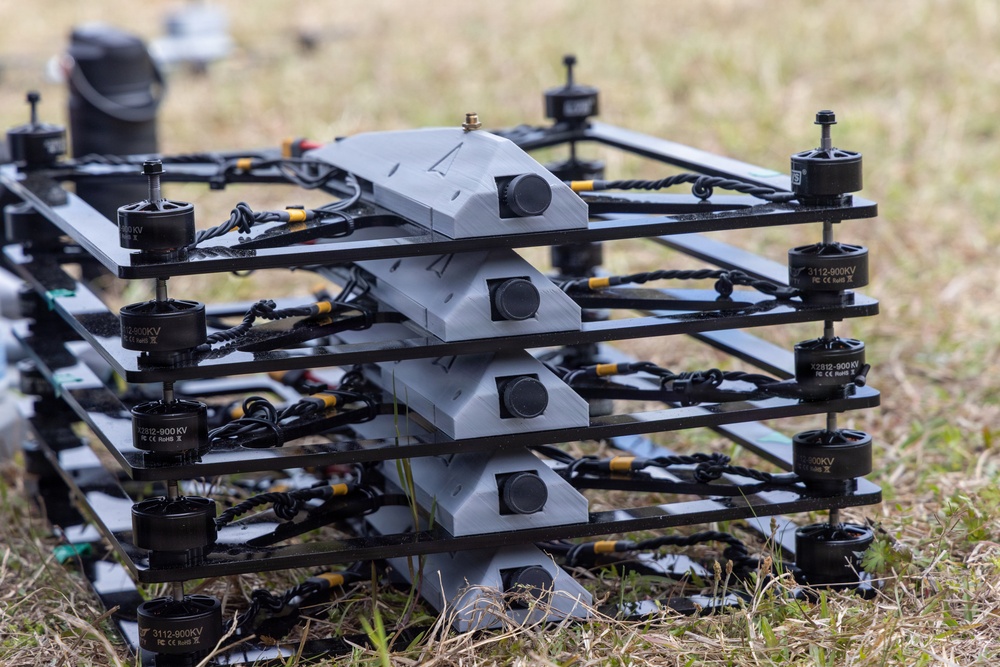
This is the edge AI imperative in its clearest form. The operational requirement is for individual nodes in the swarm — each one a modest, expendable platform — to carry enough onboard intelligence to maintain situational awareness, execute assigned tasks, identify and respond to contingencies, and coordinate with adjacent nodes without continuous direction from a human operator or a centralized compute resource. Model compression, quantized inference on low-power silicon, and distributed consensus protocols for swarm coordination are not performance optimizations. They are the minimum technical requirements for a platform to be relevant in the environment the Crucible is designed to replicate.
What Swarm Forge Means for the Industrial Base
The structure of Swarm Forge as an Other Transaction Authority-based experimentation program is a deliberate signal to the defense industrial base. OTA vehicles move faster than traditional programs of record, and the Crucible evaluation is explicitly designed to expose capability gaps across vendor offerings simultaneously — giving program managers real comparative data rather than contractor-provided test results from controlled conditions. The vendors that survive the Crucible evaluation intact will have demonstrated something that paper specifications and laboratory benchmarks cannot: that their platforms maintain operational utility when the adversary removes the conditions the system was designed to assume.
For vendors building into the Replicator ecosystem, the compliance and interoperability requirements are as consequential as the performance requirements. Open architecture mandates — specifically the Open Mission Systems and Universal Command and Control Interface standards — require that swarm platforms expose standardized APIs for mission tasking, telemetry, and payload integration. This ensures that platforms from different vendors can be managed through a common C2 infrastructure and that the swarm can be augmented or reconstituted with components from multiple sources without re-engineering the control architecture. CMMC and software supply chain integrity requirements apply at the platform level, including the autonomy stack and the edge compute firmware — the same supply chain transparency requirements that Zero Trust Strategy 2.0 extended to operational technology. Vendors who have built open, compliant, edge-optimized platforms are not simply better positioned for the Crucible. They are the only class of vendor the Replicator program's acquisition model is designed to accommodate.
The Coordinated Autonomy Problem
Beyond the individual platform requirements, Swarm Forge is probing something that individual platform vendors cannot solve in isolation: the coordinated autonomy problem. A collection of individually capable autonomous drones is not a swarm. A swarm requires distributed consensus — the ability of individual nodes to share situational awareness, negotiate task assignments, and maintain coherent collective behavior across a communications-degraded network without a centralized coordinator directing every action. The algorithms that enable this — gossip protocols for state synchronization, auction-based task allocation, multi-agent reinforcement learning for emergent collective behavior — are research-mature but not yet widely fielded in operational hardware. The Crucible will be, among other things, a live test of how far the state of the art has progressed from the laboratory to the field.
The platforms that succeed in this environment will be those whose edge compute architectures were designed to support the inter-node communication and local inference loads that coordinated autonomy demands. For attritable systems operating without persistent connectivity to a centralized coordinator, the compute architecture onboard each node is the enabling technology for swarm behavior. The Replicator initiative's June demonstration is not the end of the program — it is the point at which theoretical requirements become validated capability benchmarks. The autonomous systems industrial base has its evaluation. The field will have its answer before summer.