From LUSV to MASC: What Changed
Until 2025 the Navy envisioned a 200-300 ft Large Unmanned Surface Vessel, which CRS compared to a corvette. The March 2025 edition of the CRS report describes the Navy's concept of LUSVs "200 feet to 300 feet in length" with "full load displacements of 1,000 tons to 2,000 tons," each potentially carrying "a vertical launch system (VLS) with 16 to 32 missile-launching tubes." That edition also noted the FY2025 budget request of $54.0 million in LUSV research and development and a plan to procure the first production LUSV in FY2027. CRS, not the Navy, observed that LUSVs "might be more accurately described as optionally or lightly manned ships" in the nearer term.
That baseline is now history. The January 2026 CRS report states: "In 2025, the Navy merged the LUSV and MUSV programs into a new program called the Modular Attack Surface Craft (MASC) program." The same report describes MASC as intended "to combine robust and proven commercial vessel specifications with existing military payloads," with "a reconfigurable mission capability, accomplished via modular payloads with an initial capability to support Battlespace Awareness" through intelligence, surveillance, reconnaissance and targeting (ISR&T), counter-ISR&T and information operations. CRS adds that MASCs "are to be equipped with containerized weapons and/or sensors or other electronic payloads." On funding, CRS quotes the FY2026 budget: the program "will conduct a prototyping phase with industry," and "procurement funding will be developed as part of a decision in future budgets."
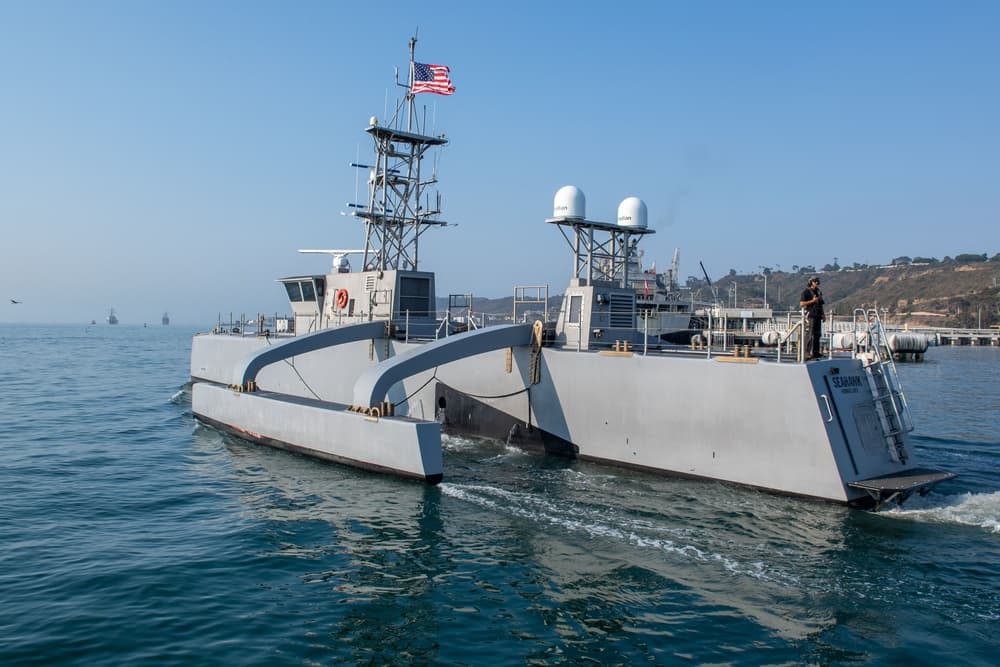
The Navy's July 28, 2025 MASC solicitation, as quoted in the January 2026 CRS report, sets out the physical envelope. The baseline vessel should "carry a minimum of two forty-foot equivalent unit (FEU) containerized payloads that weigh 36.3 metric tons each and consume up to 75 kilowatts each," and, while carrying 25 metric tons on the payload deck, should achieve a minimum range of 2,500 nautical miles at no less than 25 knots in NATO Sea State 4. Alternative solutions cover a four-payload high-capacity vessel and a single 20-foot-payload vessel. The July 31, 2025 NAVSEA release that CRS quotes carries remarks from the acting Program Executive Officer, Unmanned and Small Combatants (PEO USC), and from the program manager of the Unmanned Maritime Systems program office, which the Navy briefings CRS cites identify as PMS 406. The FY2026 budget, as quoted by CRS, says the Sea Hunter and Seahawk prototypes are experimentation vessels "operated by PMS 406" and the Navy's Surface Development Squadron, and that the USV prototypes, including NOMARS (which will transition to PMS 406 in FY26), will be used for technology maturation and risk reduction in support of the MASC program of record. The vessel pictured above is Seahawk, which the Navy's August 2025 photo caption describes as "a Medium Unmanned Surface Vessel (MUSV) prototype" operated by Unmanned Surface Vessel Squadron (USVRON) 1 and Naval Information Warfare Center Pacific.
The lineage still matters. The January 2026 CRS report records that the Defense Department's Strategic Capabilities Office (SCO) ran the earlier USV effort, called Ghost Fleet, and that "its LUSV development effort within Ghost Fleet was called Overlord," which produced the Overlord USVs Ranger and Nomad. Citing a January 12, 2022 Breaking Defense report, CRS notes that Project Overlord "has completed its work and has been shut down by the Strategic Capabilities Office," with the Overlord vessels to be transferred to the Surface Warfare Development Squadron. The public record summarized by CRS describes what those prototypes were and where they went, not what they proved under contested conditions, and the MASC solicitation now asks a harder set of questions.
What the Prototype Record Does Not Yet Establish
Neither the CRS report nor GAO-22-104567, which notes that the Navy had received two Overlord prototypes from the Strategic Capabilities Office and ordered two more without developing evaluation criteria, reports test results for the conditions MASC is being asked to meet, as far as the portions reviewed for this article show. In Spartan X's assessment, a supplier should not treat any of the following as settled by the public record reviewed for this article:
- Performance when GPS is degraded or spoofed
- Integration with a carrier strike group's or surface action group's combat systems during a realistic exercise
- Autonomy software behavior over weeks of deployment without maintenance access to the vessel
- Resilience of the command-and-control architecture to electronic warfare aimed at the data links
- How weapons-release authorization would be exercised under DoD Directive 3000.09 in an actual engagement
These are not edge cases. The 2024 CNO Navigation Plan, issued by the previous Chief of Naval Operations, said the Navy "will have to command and integrate distributed manned and robotic platforms across enormous distances in contested information warfare environments." The current CNO's U.S. Navy Fighting Instructions describe the fleet "executing Distributed Maritime Operations (DMO) through expanded maneuver at scale, even under degraded communications." The FY2026 budget, as quoted by CRS, calls the future USVs "a key enabler of the Navy's Distributed Maritime Operations (DMO) concept." A vessel proven only in permissive transits has not yet shown it can do that job. For suppliers, a favorable-conditions demonstration is the start of the test record, not the end of it.
What Congress Has Written Into Law
Two provisions of the FY2026 National Defense Authorization Act (P.L. 119-60), as quoted in the January 2026 CRS report, change what a MASC design has to prove.
- Section 130 bars any contract "for the construction, advance procurement, or long-lead material for Modular Attack Surface Craft Block 0 until the Secretary certifies to the congressional defense committees that such vessels will be purpose-built unmanned vessels engineered to operate without human support systems or operational requirements intended for crewed vessels." The optionally manned interim that CRS once described for LUSV is not a path for Block 0.
- Section 122 repeals the LUSV/MUSV limitations in Section 122 of the FY2021 NDAA and replaces them with a reliability gate. For medium and large USV programs, no detail design or construction contract may be awarded, and no procurement funds obligated, unless the contract requires "an operational demonstration of not less than 720 continuous hours without preventative maintenance, corrective maintenance, emergent repair, or any other form of repair or maintenance" on the main propulsion system, including fuel and lube oil, and on the electrical generation and distribution system.
Taken together, these provisions remove the sailor who would otherwise reset a breaker or clear a fuel filter, and they require a month of continuous running without that help. That is a design requirement for the hull and its power plant, but it also reaches the payload. A container drawing up to 75 kilowatts sits on the same electrical system that must run 720 hours untouched.
GAO's earlier oversight explains why Congress is setting conditions rather than trusting the plan. In GAO-22-104567 (April 7, 2022), GAO found that the Navy planned to spend "more than $4 billion on uncrewed systems over the next 5 years" but that the estimate "does not account for the full costs to develop and operate these systems," including digital infrastructure such as data repositories and software needed for AI. It found that the Navy "has not established a management approach" aligning its uncrewed efforts with strategic objectives, and it recommended that the Navy develop evaluation criteria for assessing each uncrewed prototype effort's readiness. GAO's product page notes that, as of September 2024, the Navy had not fully implemented most of the recommendations. Those findings predate MASC, but the prototype-criteria gap is exactly what a commercial-hull, OTA-driven program has to close before a production decision.
The Three Structural Integration Challenges
Lost-Link Behavior Is Now a Stated Requirement
The current Chief of Naval Operations, Adm. Daryl Caudle, the 34th CNO, set out his direction in U.S. Navy Fighting Instructions, released in 2026. The document calls robotic and autonomous systems (RAS) "an important feature of the current and future force," warns that "by treating these systems as novel, we carve them out of the standard model," and says "RAS capabilities must be describable in standard terms, interfaces, and outcomes." It says "confusing, obfuscating, or eluding the adversary is an absolute necessity in modern warfare," and it ties the Navy's command architecture to executing DMO "even under degraded communications."
The two earlier Navigation Plans framed the same operating problem. The 2024 CNO Navigation Plan, issued by Adm. Lisa Franchetti as the 33rd CNO, said "Distributed Maritime Operations means dispersing the fleet while concentrating effects," an approach that "demands distributing, integrating, and maneuvering people, platforms, munitions, and data across time, spectrum, and space," and named information dominance as the enabler "by which we confound the adversary's ability to find, fix, and attack our forces." It also set a 2027 goal to "integrate proven robotic and autonomous systems for routine use by the commanders who will employ them." The 2022 Navigation Plan called DMO "the Navy's foundational operating concept," and its "Leverage Deception" imperative listed "emissions control, and electronic warfare" among the measures that let naval forces operate in contested battlespaces. A vessel that must stay on a continuous link to remain safe works against all three framings.
The MASC solicitation makes the point explicit. As quoted by CRS, it asks that the vessel "autonomously and safely avoid maritime hazards and collisions with vessels, including during low visibility conditions and in scenarios where radio frequency (RF) emissions are not permitted," that it "be able to safely continue the mission if communications with the control station are lost," and that its maneuvers be "compliant with COLREGS," with the vessel able to "classify contacts in accordance with COLREGS autonomously." Command and control is to sit "at an off-hull operating station either ashore or embarked on another vessel," with an interface "capable of controlling multiple USVs simultaneously from a single control station."
For an autonomy supplier, this changes what the test record has to show. A demonstration with an operator watching over a healthy data link proves little about a vessel that must navigate traffic in emissions control, resume its mission after a link drop, and resynchronize with an operator who is supervising several other vessels at once. Spartan X's recommendation is to treat comms-denied operation as a design-required mode from the first developmental test, with the vessel logging its contact classifications and decision rationale for review when the link returns.
Weapons Payloads and DoDD 3000.09
MASC's initial capability is battlespace awareness, not strike, but the January 2026 CRS report describes MASCs as carrying "containerized weapons and/or sensors." Once a weapons container is aboard, DoD Directive 3000.09 (January 25, 2023 version) applies. It requires that autonomous and semi-autonomous weapon systems "be designed to allow commanders and operators to exercise appropriate levels of human judgment over the use of force." Such systems must go through "rigorous hardware and software verification and validation (V&V) and realistic system developmental and operational test and evaluation (T&E)" so that they "function as anticipated in realistic operational environments against adaptive adversaries taking realistic and practicable countermeasures." They must also complete engagements within a timeframe and geographic area consistent with commander and operator intentions, and "if unable to do so, the systems will terminate the engagement or obtain additional operator input before continuing the engagement."
The 2023 reissuance kept the senior-review requirement: autonomous weapon systems outside the directive's listed exceptions must be approved by the USD(P), USD(R&E) and VCJCS before formal development and by the USD(P), USD(A&S) and VCJCS before fielding. It also requires that AI capabilities in these systems be consistent with the DoD AI Ethical Principles and the DoD Responsible AI Strategy and Implementation Pathway.
Set against the solicitation's lost-link requirement, this creates a real design tension. A weapon that holds fire until it receives explicit authorization over a link cannot be employed when the link is down. A weapon that engages on algorithmic decision alone runs into the directive's design requirement. The workable space lies in between: pre-mission authorization bounded in time, geography and target class; a defined termination behavior when those bounds are exceeded; and a record of each decision for review. The January 2026 CRS report does not describe a MASC-level framework for how this will be handled, and none was found in the public sources reviewed for this article, so suppliers should build the bounding and termination logic as configurable parameters rather than hard-code one interpretation.
A credible alternative is to keep weapons employment on a crewed ship or the off-hull operating station and limit the unmanned vessel's role to sensing and carrying magazines, with every release decision made where a human has the full picture. That alternative is sensible when links are expected to hold for the engagement window, or when the program needs to field quickly and cannot yet produce the V&V evidence the directive requires. Its cost is that the vessel becomes useless as a shooter in the very conditions the solicitation tells it to expect. The Navy's choice of ISR&T as MASC's initial capability suggests it is sequencing in roughly this order.
Payload and Fleet Interfaces
Modularity splits the interface problem in two. The first interface is between the hull and the container: power, cooling, data, physical mounting and the control commands that pass between the vessel's autonomy stack and the payload. The solicitation's FEU sizing and 75-kilowatt draw define part of that interface. The FY2026 budget, as quoted by CRS, notes that "modular payloads may be developed separately by other programs or prototyping efforts and will be further developed and/or integrated into MASC Block 0 and Block 1" under the USV Enabling Capabilities line (PE 0605513N). Payloads built elsewhere will arrive with their own assumptions.
The second interface is between the payload or vessel and the fleet: sensor tracks reported in formats the fleet's combat and network systems can use, and tasking received from the off-hull operating station. The same budget language, as quoted by CRS, says these USVs "can operate aggregated with Carrier Strike Groups (CSGs) and Surface Action Groups (SAGs), as well as independently," so the fleet interface is not optional. In Spartan X's assessment, the fleet's combat systems and tactical data links were designed with crewed platforms and dedicated operators in mind, so an unmanned node cannot simply be assumed to fit. If the government does not specify both interfaces before competing vendors commit their architectures, it risks a mixed fleet in which each hull and each payload integrates differently with the same control station and combat systems. That is a sustainment problem the Navy would inherit, and it is the kind of issue GAO's call for prototype evaluation criteria is meant to catch before production.
OTA Speed and Where the Discipline Has to Come From
According to the July 2025 solicitation as quoted by CRS, "to accelerate the design, development and demonstration of MASC capabilities, the Navy will be utilizing the Other Transaction Authority pathway as outlined in Title 10 U.S.C. § 4022." Other transactions give the Navy speed and access to commercial builders. They also mean that expectations for autonomy maturity, cybersecurity, interface documentation and the test record may not be fully spelled out in a prototype agreement.
The statutory gates do not relax for that reason. Section 122's 720-hour demonstration attaches to any detail design or construction contract, and Section 130's certification attaches to Block 0 construction. A supplier that runs a fast prototype without building that evidence will meet the transition with a test record that cannot support it. Spartan X's view is that the prototype phase should be planned backward from those gates: the 720-hour run, the lost-link test events, and, for any weapons configuration, the 3000.09 review package.
Decision Questions for Program Teams
Before committing to a MASC hull, payload or autonomy architecture, program managers and system architects should be able to answer:
- Does the autonomy specification define behavior with the link up, the link lost, and under emissions control, with test cases for each that match the solicitation's lost-link and RF-silent language?
- Can the vessel be certified as purpose-built unmanned under Section 130, with no human support systems assumed anywhere in the design?
- What is the plan to run main propulsion and electrical generation for 720 continuous hours without maintenance, with representative payload loads drawing power?
- For any weapons payload, what bounds pre-mission authorization, what triggers termination, and has the approach been mapped to the DoDD 3000.09 approval steps before formal development and before fielding?
- Are the hull-to-container and payload-to-fleet interfaces documented to a government standard, or is each vendor defining its own?
- Can the off-hull operating station supervise several vessels at once, and what happens to operator workload when several lose their links together?
- At what point does the program produce data from operationally representative conditions, including GPS degradation and electronic warfare, rather than permissive transits?
- Which Type Commander will own integrating MASC vessels into fleet exercises and strike group certifications, and what coordination with PMS 406 and the Surface Development Squadron does that handoff require?
The last question matters because the prior CNO's 2024 Navigation Plan committed the Navy to "integrate mature capabilities into all deploying Carrier and Expeditionary Strike Group certifications," and the current CNO's Fighting Instructions state that "no such mechanism exists to fully incorporate RAS" into the process the Navy uses to match forces to a commander's needs. A vessel type with no fleet owner for that work will reach certification without anyone accountable for it. If more than two of these are unanswered at the design review, the program is carrying integration risk that will surface when the Navy makes its procurement decision, the point at which architectural changes cost the most.
Corrections
An earlier version of this article named specific fleet combat, network and data-link systems in the Payload and Fleet Interfaces section. Those names were not tied to a source cited in the article, so the passage now refers to the fleet's combat systems and tactical data links in general terms. The section's argument, which is Spartan X's assessment, is unchanged. An earlier version also described NAVPLAN 2024 as current Navy direction; it now notes that the current CNO has since issued U.S. Navy Fighting Instructions and presents the Navigation Plan quotations as the prior CNO's commitments.
Sources and further reading
- CRS R45757, Navy Large Unmanned Surface Vessels (USVs): Background and Issues for Congress (updated January 16, 2026), archived copy
- CRS R45757, Navy Large Unmanned Surface and Undersea Vehicles (updated March 25, 2025), archived copy
- GAO-22-104567, Uncrewed Maritime Systems: Navy Should Improve Its Approach to Maximize Early Investments (April 7, 2022)
- DoD Directive 3000.09, Autonomy in Weapon Systems (January 25, 2023), archived copy
- U.S. Navy Fighting Instructions, Adm. Daryl Caudle, 34th Chief of Naval Operations (2026)
- CNO Navigation Plan 2024 (Adm. Lisa Franchetti, 33rd CNO), archived copy
- CNO Navigation Plan 2022 (superseded by the 2024 plan), archived copy
- DVIDS, MDUSV Seahawk departs Point Loma (U.S. Navy photo, August 6, 2025)
Spartan X works directly in unmanned maritime systems design. Its Wraith autonomous surface vessel is designed around edge-compute architectures that let it operate and make bounded decisions when the data link to the fleet is intermittent or absent. That is the problem MASC's lost-link requirement puts at the center of the program: defining what an unmanned vessel does when no one is on the line, documenting that behavior so an acquisition authority can approve it, and delivering its sensor output in the formats the naval network actually uses.